


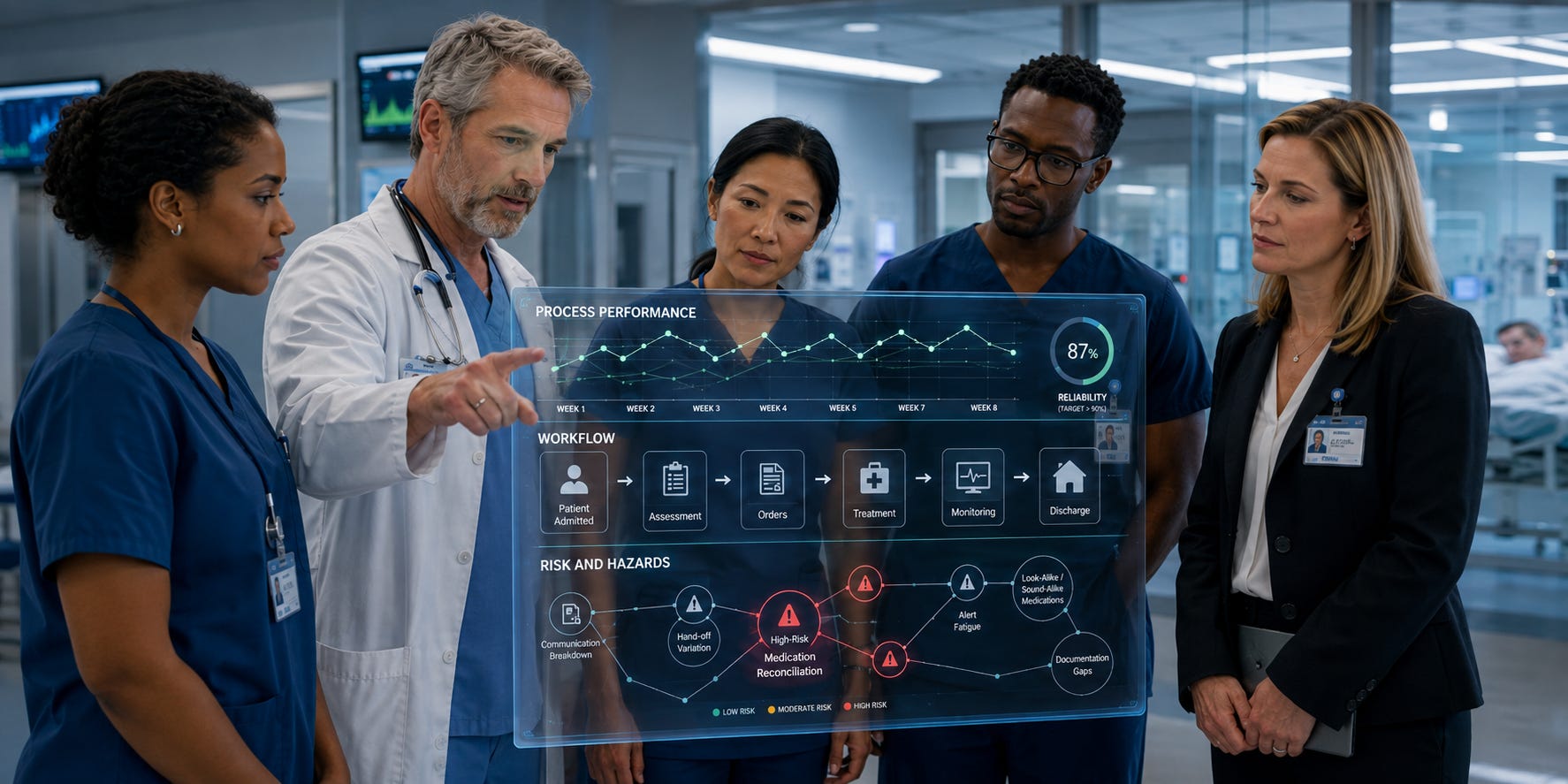
Quality and patient safety are so often paired together that it is easy to assume they are essentially the same discipline.
They aren’t.
In this piece, I want to explore three questions:
How did healthcare arrive at the way we think about quality and safety today?
What does Terry Fairbanks mean when he argues that they require different bodies of knowledge?
What should that distinction change about how we prepare people to lead this work?
My hope is that, by the end, you will have a clearer way to think about where quality improvement and patient safety overlap, perhaps more importantly, where they do not.
A few years ago, Terry Fairbanks wrote on LinkedIn that healthcare routinely conflates quality and safety.
We put them in the same departments. We combine them in job titles. We talk about “quality and safety” as if the phrase describes a single discipline. But his point was that they draw on different bodies of knowledge and require different skills.
It’s a distinction I hadn’t spent enough time absorbing until my recent conversation with Terry on the Leading Quality podcast. He shared a patient safety case involving a suspended nurse and the difference started to become much more concrete for me.
I wrote a short LinkedIn post afterward about what I had learned. The response was much larger than I expected.
That made me wonder whether the confusion wasn’t mine alone.
If this distinction already feels useful, consider sharing this article with someone who works in quality or patient safety. I suspect many of us have used the phrase “quality and safety” for years without fully unpacking what it contains.
We are still figuring out what “quality” means
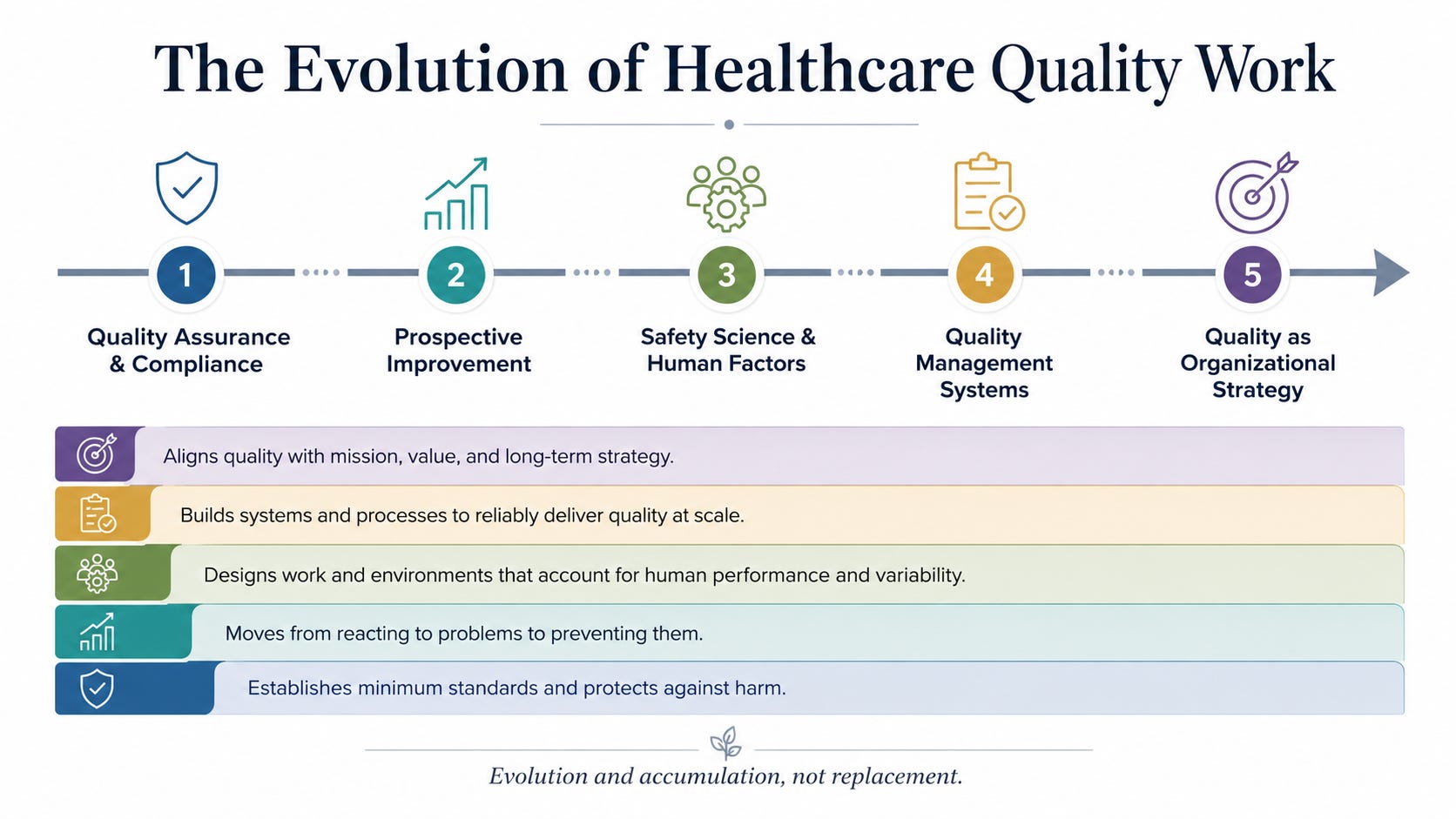
Healthcare has been concerned with quality for a long time. But what we mean by quality work has changed substantially.
An earlier model was largely retrospective. We looked in the rear view mirror to see if we met standard or followed the policy. We reviewed charts, investigated cases, audited performance, checked compliance and tried to assure ourselves that care was acceptable.
That work still occupies an important foundational role.
But over time, healthcare learned the limitation of relying on defects to tell us what needed improvement. By definition, that meant our starting point was always something that had already happened.
Improvement science, Lean, PDSA, statistical process control and related approaches taught us to examine the processes, reduce variation, and consistently improve our most important outcomes.
That represented an important shift: from inspecting quality to designing for it.
The modern patient safety movement added another layer.
Safety science pushed healthcare to think more deeply about how people behave in complex systems, how technology and workflow interact, why reasonable people make errors, how hazards develop, and how systems perform when conditions differ from what their designers expected.
Human factors. Systems thinking. Just Culture. Event analysis. Resilience. Risk mitigation. Teamwork. Psychological safety.
These were not simply additional QI tools.
They came, in important ways, from different intellectual traditions.
And now our understanding of quality is expanding again.
We are increasingly talking about quality management systems, organizational learning, Whole System Quality and Quality as an Organizational Strategy, not something produced by a Quality Department, but something embedded in how an organization is managed.
None of these stages completely replaces what came before.
Together, though, they suggest something important:
Healthcare is still constructing its understanding of what quality and safety work actually consists of.
Quality and safety overlap. They are not identical.
One of Terry’s simplest distinctions is also one of the most useful.
Quality improvement often involves trying to move a process toward a known desired state.
Suppose we know the evidence-based bundle that reduces central-line infections. The challenge becomes creating a system in which the right care happens reliably.
That calls for capabilities like process design, measurement, understanding variation, standard work and testing changes.
Safety often presents a different kind of problem.
A serious event may emerge from an unexpected interaction among a clinician, a device, a workflow, an interface, environmental conditions and organizational pressures.
The questions change:
Why did this action make sense to the person at the time?
How did the design of the system shape what happened?
What hazards were present before the event?
What happens when the system is under stress?
How do we prevent an individual error from becoming patient harm?
Those questions require capabilities that many people with excellent improvement training have never formally learned.
Being skilled at Lean, Six Sigma or PDSA does not necessarily mean someone understands human factors, safety engineering, cognitive bias, event investigation or resilience.
And the reverse is also true.
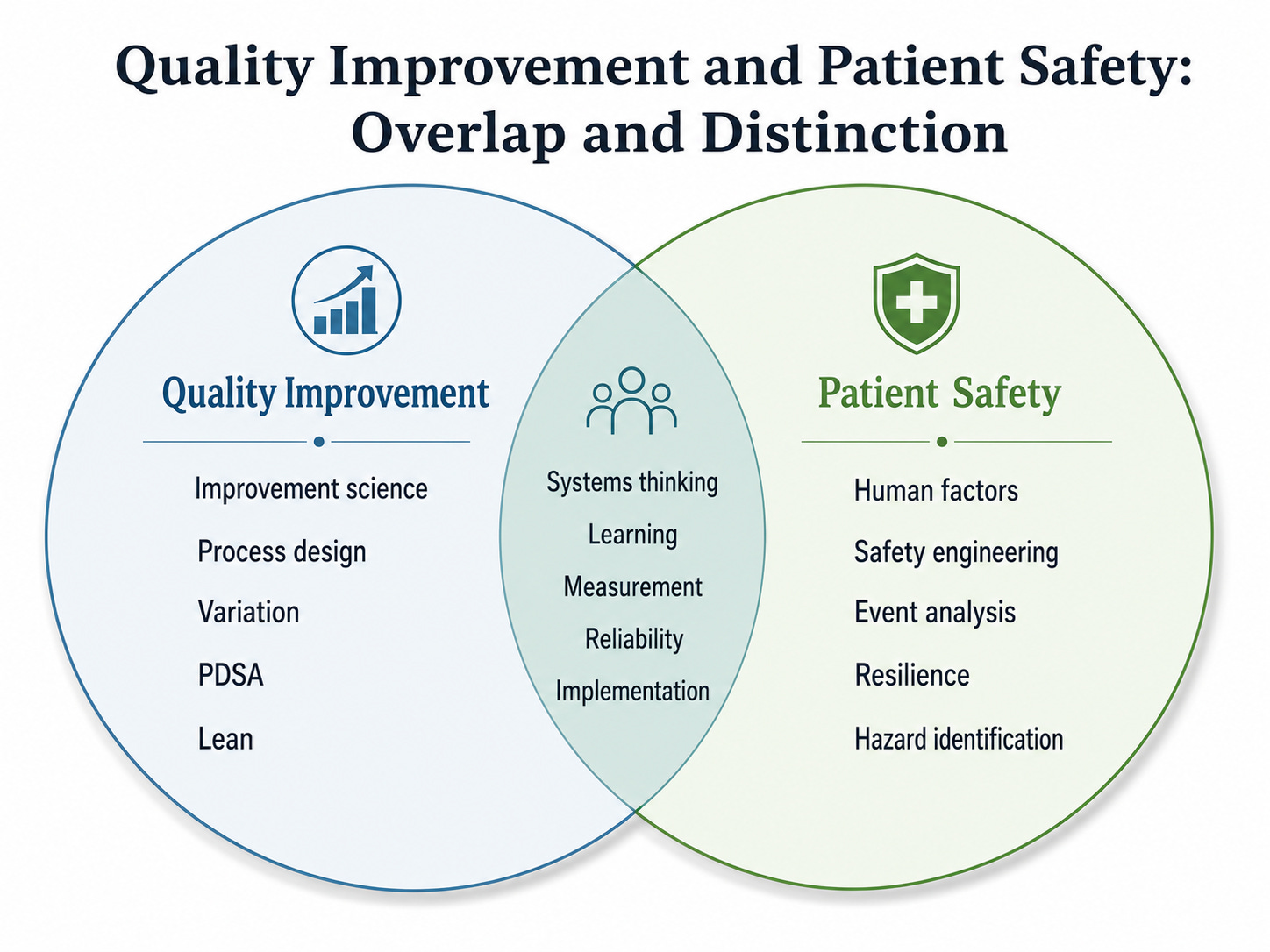
There is substantial overlap.
Improvement methods can absolutely make care safer. Safety work often requires improvement methods to implement and test changes.
But overlap is not identity. Quality and safety may belong together as aims. That does not mean they come from the same science.
Sometimes the difference changes what we see
The case Terry discussed with me helped make this real.
A nurse was suspended after a serious patient safety event. A superficial interpretation could focus on the individual: someone made an error, someone failed to follow the expected process, someone therefore needed correction. But a deeper safety analysis asks different questions:
What was happening in the system around the nurse?
How did equipment design contribute?
What conditions made the error possible or even understandable?
What changes would reduce risk for the next clinician and the next patient?
That is one reason safety science matters.
If our model of safety is simply “find the bad outcome and improve the process,” we may misunderstand the nature of the problem. And if we misunderstand the problem, an excellent improvement method can help us implement the wrong solution more reliably.
What should a safety leader actually know?
Terry has described seeing candidates for patient safety leadership positions emphasize Lean or Six Sigma credentials while having little formal training in safety itself.
That should make us uncomfortable. Not because every quality leader needs another credential or because the answer is to build bigger professional silos around quality and safety.
The question is more basic. If someone has “patient safety” in their title, what should we reasonably expect them to know?
Can they analyze human error without defaulting to “the policy wasn’t followed”?
Can they recognize when poor design is shaping behavior?
Can they distinguish the way work is supposed to happen from the way it actually happens?
Can they identify hazards before enough people are harmed to create a measurable trend?
Can they design stronger mitigations than another reminder, training module or policy?
These seem like reasonable expectations. But I’m not sure healthcare has consistently defined them. Perhaps our confusion about quality and safety is not simply a failure to distinguish two established disciplines.
It may reflect something more interesting:
Healthcare is still defining what these disciplines are, what knowledge they require, and how they should fit into the way we run healthcare organizations.
The answer is not necessarily to separate quality from safety organizationally. It is to stop assuming that putting them together makes their underlying competencies interchangeable.
Because we cannot build safer systems if we have not first become clear about what it actually takes to make them safe.
Continue the conversation
What is one capability you think every patient safety leader should have that is still too rarely taught?
I’d genuinely like to hear how people working in different parts of healthcare answer this.
Listen: Leading Quality
This article was partly inspired by my conversation with Terry Fairbanks on Leading Quality, where we discussed the patient safety case that made this distinction much more concrete for me.
Leading Quality explores how healthcare systems improve, why meaningful change is difficult, and how leaders can build organizations capable of learning and improving consistently at scale.
If this was useful
Subscribe to Leading Quality for future essays on healthcare quality, safety, improvement and organizational learning.
Share this article with someone who works in quality, safety or healthcare leadership.
Respond to the question above. I read the comments and often use the discussion to shape what I explore next.
Partnerships
Interested in partnering with Leading Quality?
If your company is aligned with our goal to improve healthcare, click here to discuss sponsorship opportunities.